
I was fortunate enough this weekend to go on a historical excursion to Bayview Cemetery with Marissa McGrath from The Bureau of Historical Investigations.
As soon as we pull in, Marissa has me stop near the road to pay respects to the grave of F. L. Dames. She fills me on on the history of one of Bellingham's most notorious murders.
 |
| F. L. Dames - Died 1905 |
Here is what she wrote about it on The Bureau's website:
"Dames was bludgeoned to death in his butcher shop in 1905. His thirteen year old delivery boy discovered him the following morning, his skull pinned to the ground with a screwdriver and the top of his head chopped off. No one had been arrested. For a while, it was assumed that some robbers had killed him. That was until a Maple Falls man was tried in Stevens County, Washington. He had killed a woman he was engaged to for her money and was discovered to have likely murdered at least 3 other people. After reviewing the evidence, a local detective figured out that this murderer had lived in Bellingham at the time of Dame’s death, and that witnesses had seen the two arguing the week before Dame’s death." - From This is Frederick Dames
Note that Dames' butcher shop was located where the Redlight is today. They recently opened up "The Red Room" just opposite the bar. As you are enjoying one of their excellent drinks, you should say a prayer for the murdered soul of Frederick Dames. And if you look up towards the ceilings, you can see a row of meat hooks still mounted near the ceiling. Violent poetic history.
 |
| Nicholas Caufman - Died 1906 |
 |
| Nicholas Caufman - Died 1906 |
 |
| Nicholas Caufman - Died 1906 |
Just down the road is a tombstone for Nicholas Caufman, died 1906, who belonged to the fraternal organization, Woodmen of the World. [More information about the Woodmen of the World can be found on my other site, The Shaving Mug Review.] The WOW are noted for the elaborate gravestones. This is from the Woodmen of the World website:
When Joseph Cullen Root founded Woodmen of the World more than 100 years ago, one of his objectives was to provide a decent burial for all members.
Root made a special effort to honor deceased Woodmen. He created Woodmen Memorial Day, celebrated on June 6 each year, and included the following statement in the Objectives of Woodcraft: "... to give honorable burial to our sacred dead ..."
Early Woodmen certificates provided for a death and a monument benefit. Gravestones were originally furnished to members free of charge and later were offered only to those who purchased a $100 rider to their certificates.
However, during the 1920s the Society stopped providing stone markers to members when the cost of gravestones increased and cemeteries began prohibiting above-ground markers for maintenance reasons. The monument rider was discontinued and converted to an extra $100 of insurance protection, but for many years after that, members and lodges arranged for markers and monuments on their own.
Woodmen gravestones vary greatly in size and shape. Some resemble a tree stump, others a stack of cut wood. There are elaborate hand-carved monuments, simple stone markers and stake-type markers driven into the ground.
 |
| Thomas S. Dahlquist - Died 1939 |
The grave for Thomas S. Dahlquist is just behind the Caufman grave. Earlier, Marissa and I had stopped for a lunch at the new Thai restaurant, Maikhamm which happens to be located in the Dahlquist building. Thomas Dahilquist opened Bellingham Bay Grocery Company on the lower floor while his wife operated a hotel in the rooms above. At one point there was even a car dealership in the basement. [source]
In 2013, the Good Time Girls were being filmed in the Dahlquist building and experienced an a strange anomaly:
We drive down the road a bit until we came to an unpaved stretch. Just off the road is a broken gravestone propped up against a tree. We share some speculation about the tree sending roots down into the body beneath. Nourishing elements of the man's mortal being now bound into the branches.
 |
| Edward ??? |
Just beyond this, Marissa finds a marker for the lovely and evocatively named grave of Kitty Bone. Kitty was born on November 3, 1880 and died on February 24, 1902. The COB database lists her name as Mrs. Kate Bone. No other members of the beautifully named Bone family are buried in Bayview.
 |
| Kitty Bone - Died 1902 |
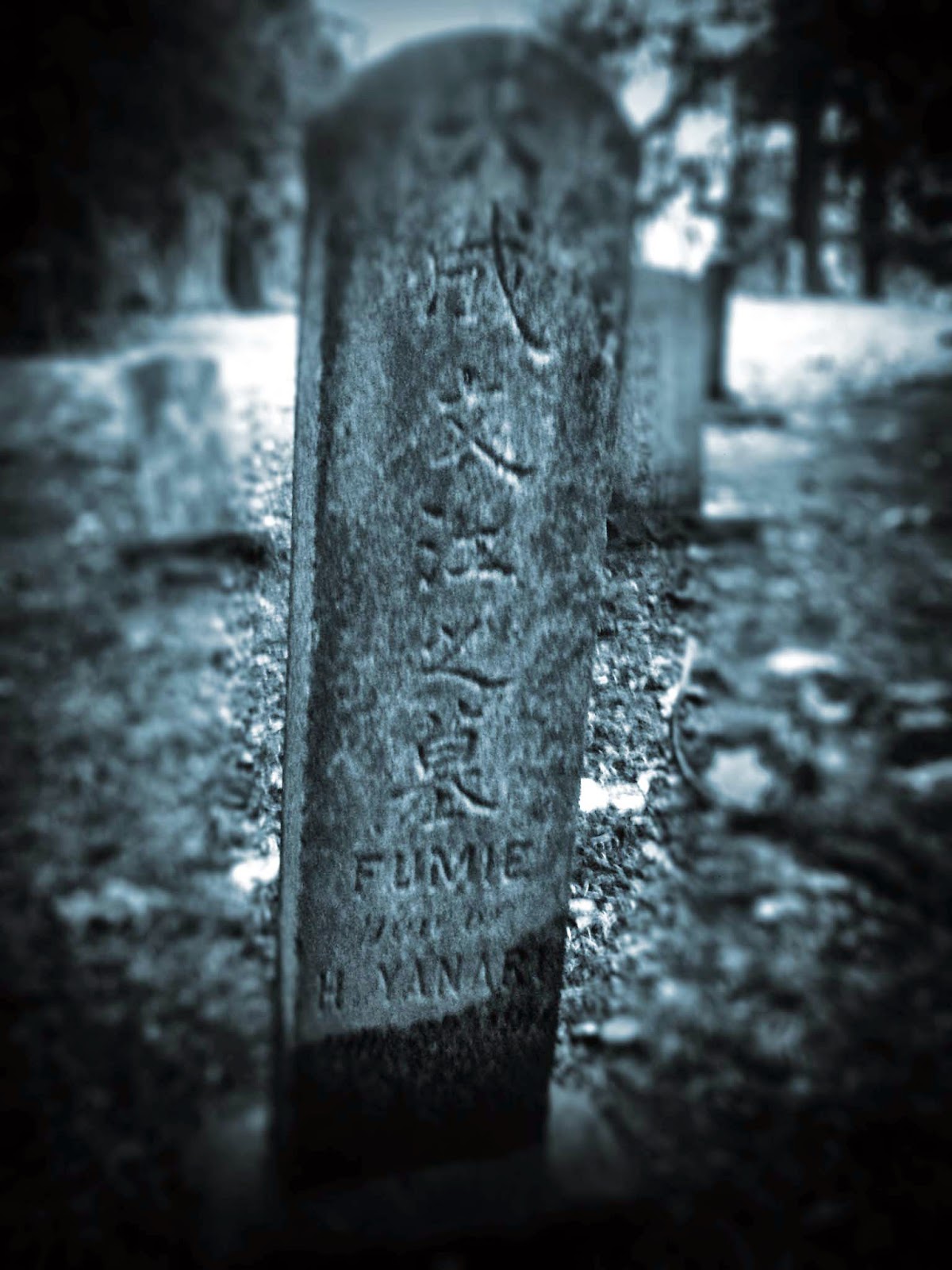
Further on is a leaf covered dirt track that leads to a group of graves for the Japanese, who we assume were granted this space on the outskirts to bury their families. Many of the grave markers are inscribed with Kanji. There are also a lot of graves for babies. It is nice here: a quiet and beautiful place under the trees.
 |
| The Japanese Section in Bayview Cemetery |
 |
| Japanese Gravestone in Bayview Cemetery |
 |
| Baby Marker in the Japanese Section of Bayview Cemetery |
We drive up the hill and take a left to the crossroads where the Angel of the Luminous Eyes looks down upon all who pass by. Marissa tells me that certain individuals periodically come out to paint the Angel's eyes with luminescent paint. If you come into the graveyard at night, the Angel's eyes may be glowing.
|
| The Angel of the Luminous Eyes at Bayview Cemetery |
Just beyond the Angel is a large bench / cross monument for a local poet and writer Ella Higginson, who died in 1940. Along the base are inscribed the words: "Yet, am I not for pity - trembling I have come face to face with God." Moss and lichen obscure many of the letters. And the bench seems difficult to sit upon. But it is all quite decadent and lovely. [More information about he Higginson grave.]
 |
| Ella Higginson - Poet and Writer - Died December 30. 1940 |
 |
| "Yet, am I not for pity - trembling I have come face to face with God." |
We walk down the hill behind us. Marissa points out several markers for Civil War veterans, informing me that there are a couple of hundred in Bayview. Many soldiers came out to this area to get away from the horror and aftermath of the Civil War.
 |
| Edmund Gaudette - Died 1916 |
Around the corner is the large grave of Edmund Gaudette. The only information I could find on him is a brief reference in a court case as listed in The Pacific Reporter, Vo. 280:
The facts essential to be stated are these: Edmund Gaudette and Laura M. Gaudette were married in 1853, and for some years prior to Mr. Gaudette's death, in 1916, resided in the city of Bellingham.
Below this is a single rose on the grave for Baby Caulkins. The COB Database lists it as "Infant Caulkins 9-27-16" - which adds a sweet mystery.
 |
| Baby Caulkins - Died 1916 |
We head back toward the center of the cemetery, where some of the most famous bones of Bellingham are buried.
An imposing a solid marble slab marks the grave of the Henry Roeder, generally acknowledged as the "Founder of the Whatcom Settlement" - what eventually became Bellingham.
 |
| Henry Roeder and Elizabeth Roeder - Died 1902 |
 |
| The Best Virgil to Guide One Through the Graveyard: Marissa McGrath |
The always informative Skagit River Journal documents this interesting passage from Wes Gannaway's Whatcom Then and Now:
He shares this research from the Hubert Howe Bancroft papers — an interview with Henry Roeder at Port Townsend in June 1878: "While he (Roeder) was at Pt. Townsend [in 1852] Capt. Pattle arrived on his way to Olympia to file on a claim. He was an English subject, and he had discovered coal in the place called Bellingham Bay and he told Plummer [owner of Port Townsend's only trading post along with E.B. Hastings] he had also discovered a waterfall, a good one, and would give the information for $1000 to anyone who wanted to locate there. Plummer told him (Roeder) how to get to the falls without paying any 1000 dollars; the Indians would take them there for dollar a day. They took up this plan and camped the first night inside of Deception Pass on Whidbey Island because of the stress of the weather. The next day they camped on Guemes Island where they killed a wild dog in the night. The place was called Dog Island for many years. The third day found them at the future site of Whatcom. They met with Chief Chowitzet of the Lummi Indians who invited them to stay and offered help to build a sawmill." As with all anglicized Indian names, you will find many spellings; Lelah Jackson Edson spells the chief's name as either Cha-wit-zit or Chow-its-hoot.
Marissa directs my attention across the road to an imposing draped obelisk that marks the graves of the Eldridge family. She humorously speculates that it almost seems as if Capt. Edward Eldridge wanted to "one-up" Roeder. There certainly is an element of compensation for some insecurity in the design. From the COB Database, it appears there are five members of the family are on the plot, including an infant that died in 1921.
 |
| The Eldridge Obelisk |
Edward Eldridge, originally from Scotland, came to Bellingham from San Francisco in 1853 along with another of the city's founding fathers, Captain Henry Roeder. When Eldridge settled in Bellingham the Federal Land Policy allotted 160-acre claims to each person. The current 2.2-acre Eldridge Homesite on a bluff overlooking Bellingham Bay is what remains from Edward Eldridge's, and his wife Teresa's, 320-acre claim that made up much of north Bellingham.
The first enterprise of Edward Eldridge upon his arrival in Bellingham was to open a lumber mill. The Eldridge mill would supply San Francisco with much of the wood needed to rebuild the city after their great fire. Eldridge soon quit the lumber industry and began teaching at Sehome School while continuing his mining ventures. After exploring a career in mining Eldridge became the first legislator ever elected from Whatcom County to the House of Territorial legislature. Eldridge continued to be a distinguished political figure in Bellingham until he died from Paresis in 1892 at the age of 63, shortly after his return as a delegate to the National Republican Convention.
Across the road, there is a fresh pile of roses and a few graves with unusual mementos recently left upon them:
 |
| Memorials at Bayview Cemetery |
 |
| Memorials at Bayview Cemetery |
 |
| Memorials at Bayview Cemetery |
Bayview Cemetery is a beautiful and fascinating cemetery. Of course, it helps to have an informative guide from the Bureau of Historical Investigation with you. But even without a guide, there is plenty to explore hike around. It is a perfect place to contemplate one's life and be reminded of Memento Mori - that there is only one certainty in this world: you too will one day die.
Much thanks to The Bureau of Historical Investigation and Marissa McGrath. If you are looking for more information about the history of Bellingham, especially of the more notorious and fascinating sort, I encourage you to head over to the Bureau of Historical Investigation. There is no better place to find books, photographs, historical artifacts and fascinating curiosa about Bellingham and the surrounding areas.


